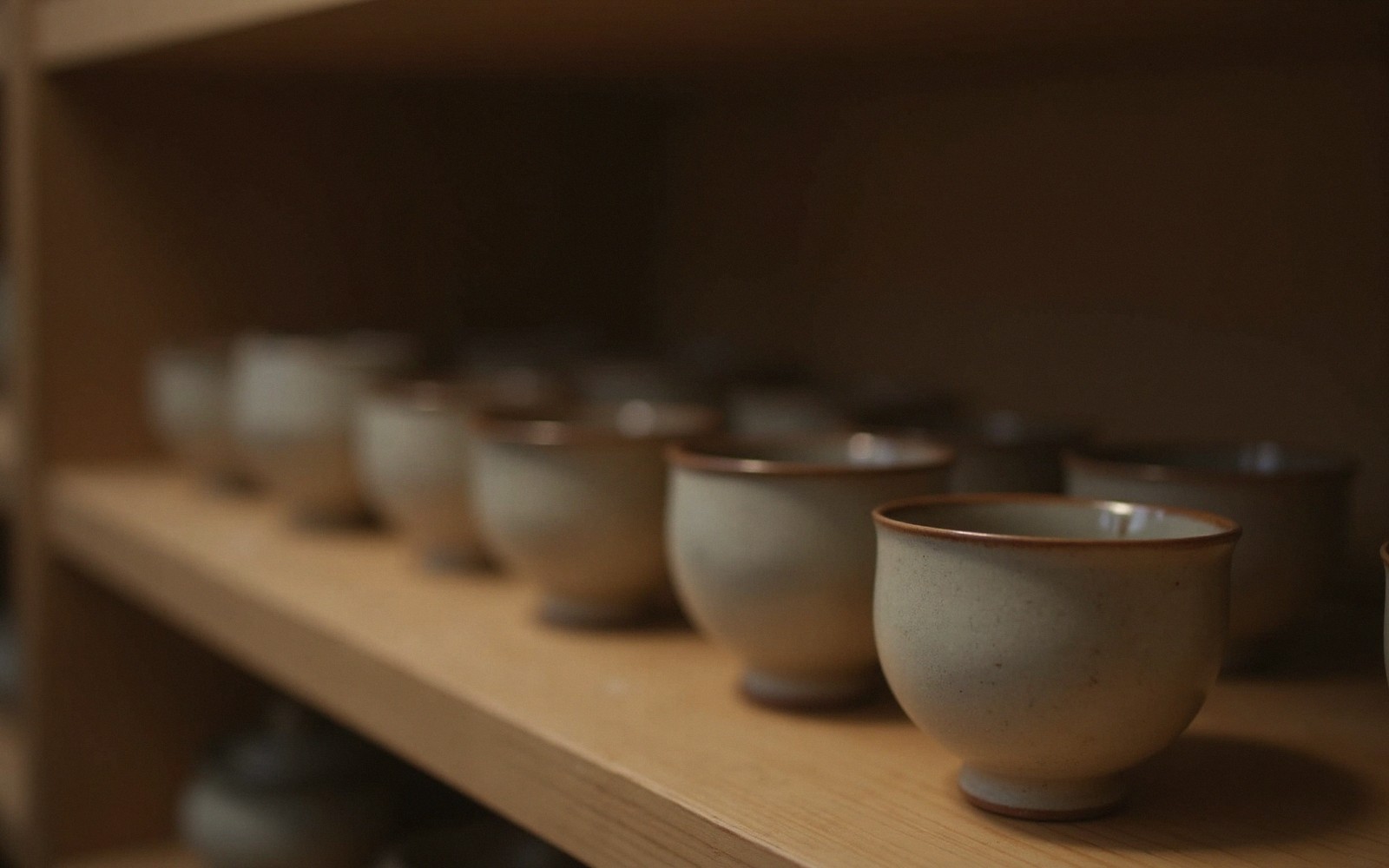
The thumb-print in the clay, the uneven glaze — why the handmade bowl feels different in the hand.
OneWhat the Hand Leaves Behind
Pick up a bowl thrown on a wheel and you notice it almost immediately — not a flaw exactly, but a record. A slight asymmetry in the lip. A shallow ridge where the potter's fingers climbed. A patch of glaze that pooled thicker on one side, breaking to a deeper colour at its edge. These are not errors that escaped quality control. They are the piece itself.
Industrial ceramics are made to tolerance: every cup in a run is within a fraction of a millimetre of its neighbours. The goal is invisibility — the object should not call attention to its own making. A handmade bowl works from the opposite premise. It wears its process openly, and that openness is precisely where its character lives.
The Japanese have a word for this quality. Tezukuri simply means "made by hand," but the aesthetic weight it carries connects to something older: the understanding, embedded across East Asian craft traditions, that evidence of human effort is not a defect to be erased but a value to be honoured. A Song dynasty tea bowl, 900 years old, is still studied not despite its irregularities but because of them — the way iron in the clay bled through the glaze and left rust-coloured blossoms (yōhen, in Japanese appreciation of such effects) that no two firings ever reproduce.
TwoThe Kiln Has Its Own Say
Clay is only half the story. What fire does to it is the other half, and fire is not entirely controllable — which is part of the point.
In a wood-fired kiln (anagama in Japanese, a form with roots in Korean and ultimately Chinese technology), the ash from the burning wood drifts onto the ware and fuses with the clay surface under intense heat, creating a natural ash glaze with surfaces that shift from matte to glassy, from pale grey to warm amber, sometimes within a single piece. The potter loads the kiln with intention; the kiln answers in its own way. Experienced potters speak of firing not as a production process but as a collaboration — they set the conditions and then, in a real sense, let go.
This is not mysticism. It is an accurate description of the process. The uneven heat, the movement of ash, the particular chemistry of one batch of clay meeting one firing atmosphere — these variables are too complex to fully predict. What emerges has qualities that the maker shaped but did not wholly choose, and a viewer with any sensitivity can feel that. The object holds both agency and accident, intention and surprise.
Reduction firing — where oxygen is restricted inside the kiln at a critical point — alters how metal oxides in the glaze behave. Copper, which in an oxidising atmosphere produces greens, turns red in reduction: the luminous oxblood (Chinese: niúxuèhóng) that Qing dynasty potters achieved and that still astonishes. Iron produces celadon, that soft, almost aqueous grey-green associated with Longquan ware in Zhejiang province, which was being refined as early as the Five Dynasties period in the tenth century. These colours are not painted on. They are coaxed out of the material itself by heat, atmosphere, and the particular chemistry of a glaze formula that may have taken a lineage of potters generations to develop.
What emerges has qualities that the maker shaped but did not wholly choose, and a viewer with any sensitivity can feel that.
ThreeWhy It Feels Different in the Hand
There is a tactile argument for handmade ceramics that has nothing to do with aesthetics and everything to do with how objects are experienced physically. A wheel-thrown bowl is round but not perfectly round; when you hold it, your palm makes contact with a subtly varied surface. Machine-made ware presents a uniform curve. The difference is small but not trivial — it is roughly the difference between a handshake and the feeling of touching a wall.
Wabi-sabi — the Japanese aesthetic that locates beauty in the imperfect, the incomplete, and the impermanent — finds one of its clearest expressions in ceramics. The philosophy is not a mandate for shoddiness. A careless chip is still just a chip. The distinction wabi-sabi draws is between imperfection that is incidental and imperfection that is intrinsic — that arises from the nature of the material, the limits of the human hand, or the vagaries of fire. These are not failures. They are the record of a real encounter between maker, material, and process.
There is also something quieter to say about using a handmade bowl, day after day. Industrial objects are designed to disappear; they do their job and ask nothing of your attention. A handmade piece is different. It asks, gently, to be noticed — the heft of it, the slightly thicker foot, the glaze break you find yourself returning to the way you return to a line in a poem. Living with such objects is a small, steady practice of attention, which is perhaps why they sit so naturally alongside tea, slow mornings, and the general project of noticing your own life.
The thumb-print in the clay is not an accident that a better potter would have avoided. It is simply proof that someone was there.
Longquan (Zhejiang province, China)
historic centre of celadon production, active from at least the Five Dynasties period
Mentioned in this guide
Song dynasty
Chinese dynasty (960–1279); period of celebrated ceramic refinement
Mentioned in this guide
Qing dynasty
Chinese dynasty (1644–1912); period noted for refined oxblood glazes
Mentioned in this guide
- 10th c. · LongquanRefined celadon glazes emerge in Zhejiang.
- 960–1279 · Song dynastyTea bowls reach a celebrated, understated restraint.
- 1644–1912 · Qing dynastyRich oxblood and copper-red glazes are perfected.