The Japanese aesthetic that finds grace in the worn, the asymmetric, and the impermanent — and why it matters more than a design trend.
OneWhat the Words Actually Mean
Wabi-sabi is not a single word but a pairing of two, each with a long, slippery history. Wabi once carried connotations of loneliness and poverty — the cold, exposed feeling of having little. Over centuries, particularly through Zen Buddhist sensibility and the culture of the tea ceremony, that meaning softened and deepened: the sparse, the quiet, the sufficient. Sabi is older still, rooted in classical Japanese poetry, where it described the patina of age — the rust on iron, the lichen on a garden stone, the way a thing becomes more itself as time works on it. Together, the compound names a way of seeing that finds beauty precisely where conventional aesthetics would not think to look: in the cracked, the faded, the lopsided, the almost.
It is not, strictly speaking, a philosophy in the way that Taoism or Zen Buddhism are philosophies — no founding text, no formal doctrine. It is better understood as an aesthetic sensibility so deeply embedded in Japanese cultural life that it became a lens. The fifteenth- and sixteenth-century tea masters, most famously Sen no Rikyū, were central to that crystallisation. Rikyū's preference for rough, unassuming vessels over polished Chinese porcelain — for the irregular Raku ware bowl over the symmetrical — was itself a kind of argument: that refinement could run inward rather than outward, that restraint was its own sophistication.
TwoWhat It Looks Like, and How to See It
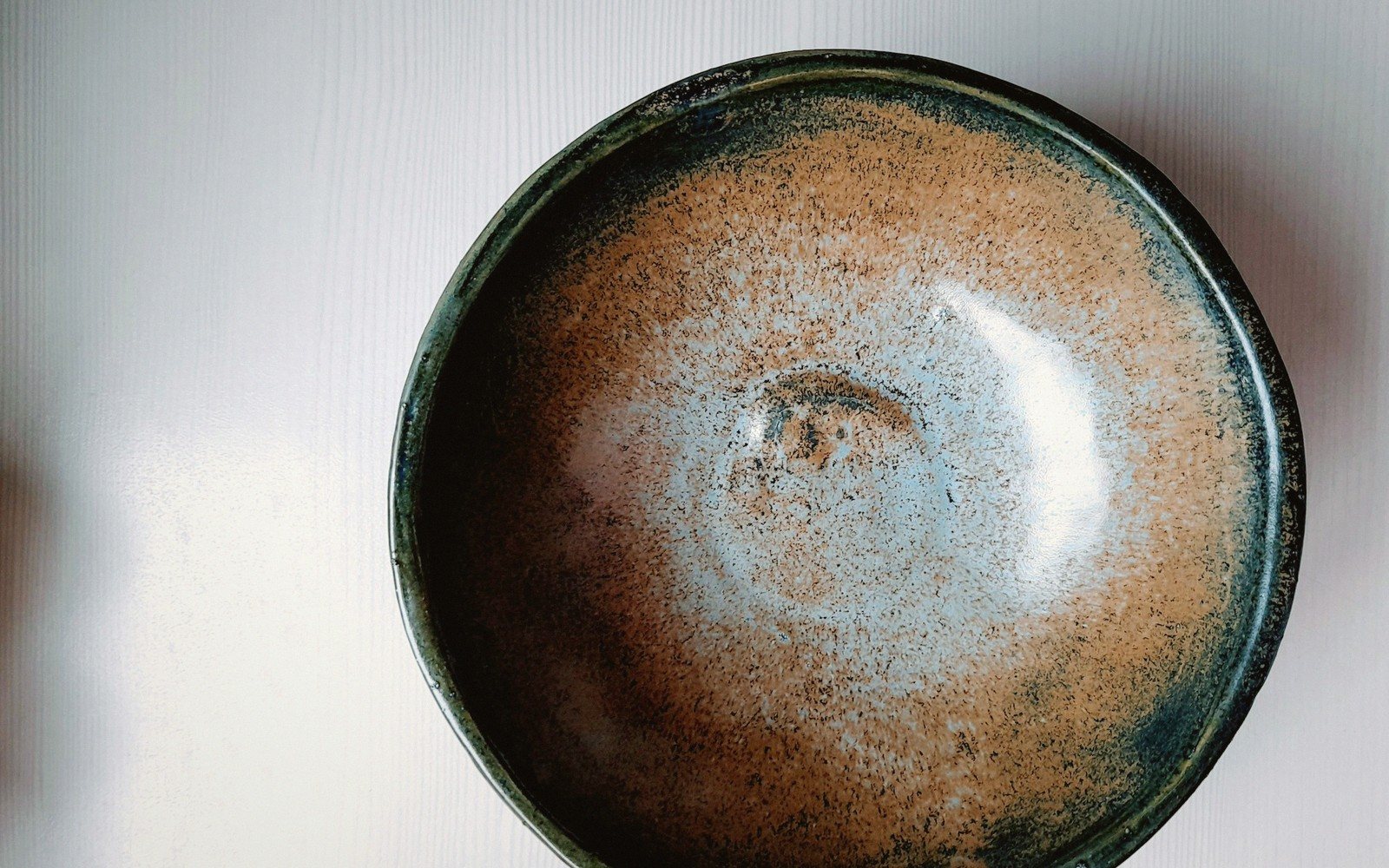
In practice, wabi-sabi shows up in textures and materials more than in shapes. A glazed ceramic bowl with an uneven rim. A linen cloth worn thin at the fold. A wooden floor whose grain has deepened with use. A garden where moss has been allowed — encouraged, even — to colonise the stone. The handmade ceramics tradition in Japan takes this seriously: the thumb-print left in the clay, the kiln-blush that was never planned, the small warping that makes the piece unmistakably singular. These are not flaws to be corrected before sale. They are evidence of process, of time, of the fact that the thing was made by a human hand.
The aesthetic connects, at its roots, to Buddhist ideas about impermanence — the understanding that nothing holds its form forever, that the cherry blossom is beautiful partly because it falls. Where Western decorative traditions have often sought the permanent and the symmetrical, wabi-sabi keeps one eye on transience. The crack in the glaze is not a failure of the firing; it is a record of temperature and time, as real as a growth ring in timber.
This is also why the concept is linked to mono no aware — "the pathos of things," the bittersweet feeling that arises when beauty and fleetingness are perceived at once. The two ideas are not identical, but they breathe the same air.
They are evidence of process, of time, of the fact that the thing was made by a human hand.
ThreeLiving With It, Without Turning It Into a Trend
In recent decades, wabi-sabi has been enthusiastically adopted as an interior design keyword, which has introduced some irony: the aesthetic of the undesigned being deliberately designed, the accidental being carefully purchased. It is worth returning to the source to notice the difference. Wabi-sabi in its original register is not an arrangement of artful objects; it is a quality of attention. You can bring it to a chipped mug you already own, a bare wall, an ageing floorboard, as readily as to anything bought for the purpose.
The practical shift it asks for is actually quite small: a willingness to stop seeing the worn and the irregular as problems awaiting resolution. The handle re-glued with gold lacquer — kintsugi, the related practice of repairing with gold — makes the break part of the object's story rather than its blemish. The garden left a little rough at the edge is more honest than one that appears never to have been rained on.
What wabi-sabi ultimately offers is not a style guide but a reorientation — a quiet argument that things need not be finished, flawless or new to deserve your full attention. The beauty was always there. It was just waiting for a different kind of looking.
Sen no Rikyū (1522–1591)
Japanese tea master central to defining the wabi aesthetic in tea culture
Mentioned in this guide
- Muromachi JapanZen-tinged taste begins to prize restraint over splendour.
- 16th c. · Sen no Rikyū (1522–1591)Wabi tea gives the sensibility its clearest, most exacting form.
- Ever sinceWabi-sabi names a beauty found in the worn, asymmetric and impermanent.