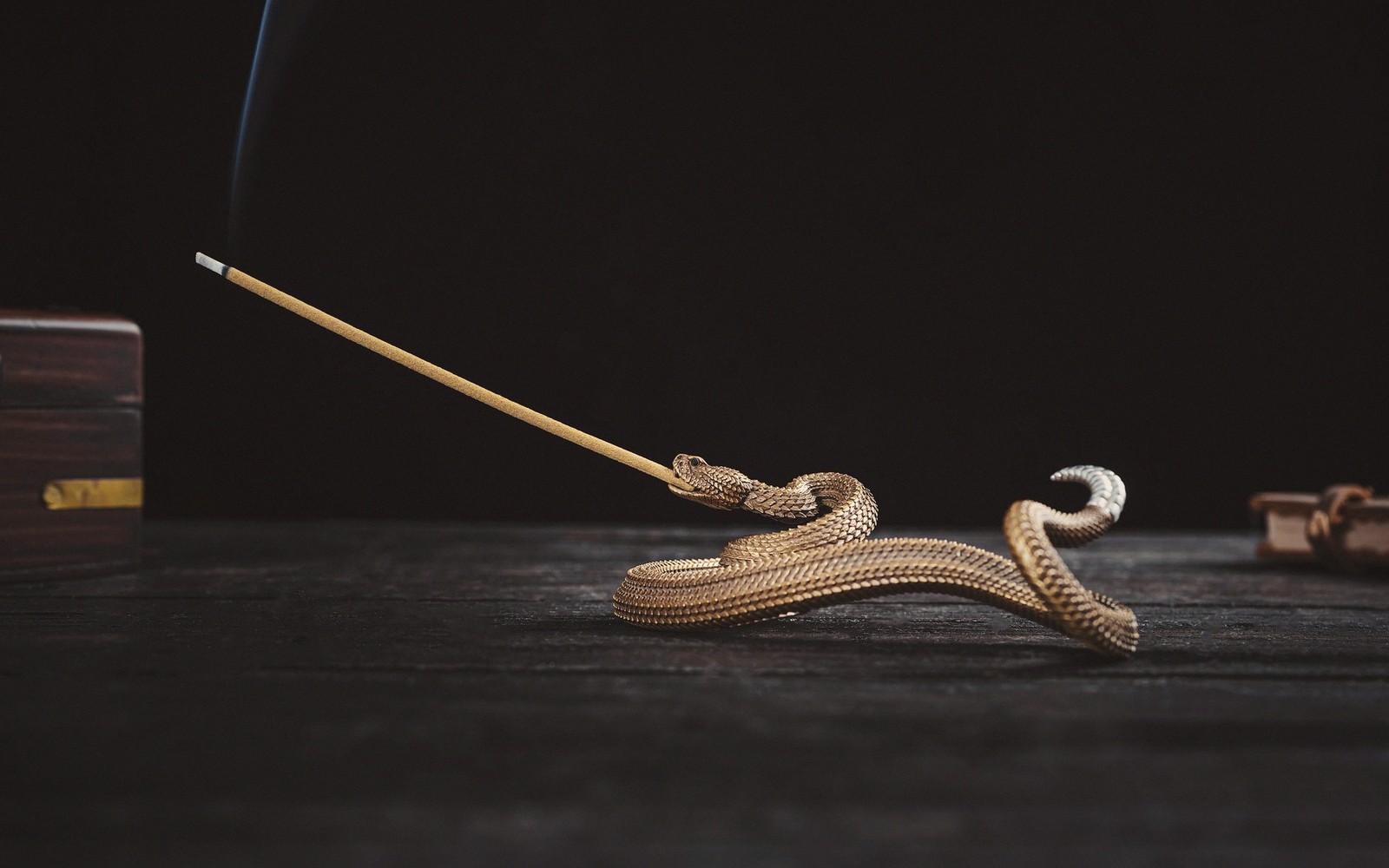
A thread of smoke, a marked moment — how burning incense became one of the oldest ways to shape time and attention.
OneThe Simplest Ritual
Light a stick, watch the smoke rise, and something shifts. Not dramatically — just a quiet recalibration of the senses, the way a room changes when you open a window. This is what incense has always done: mark a moment, signal a threshold between the ordinary and the attentive.
The practice is ancient and genuinely pan-Asian. In China, aromatic woods and resins were burned in bronze censers as early as the Han dynasty. In Japan, kōdō — the formal Way of Incense — developed alongside the tea ceremony as one of the classical arts, requiring practitioners to "listen" to incense rather than merely smell it. The word itself is telling: listening asks for patience that sniffing does not.
The core materials are few: aloeswood (agarwood, known in Japanese as jinko and in Arabic-influenced trade as oud), sandalwood, and various resins including frankincense and benzoin. These were transported along the same routes as silk and tea, their value measured by weight and rarity. A sliver of premium aloeswood remains extraordinarily costly today — evidence that genuine quality was never cheap and has not become so.
For everyday practice, the craft is unpretentious. A small ceramic or brass holder, a stick of honest sandalwood or a coil of Taiwanese mo incense, a moment before you sit down to work or read. The smoke doesn't purify anything in any mystical sense — it simply announces: here, now, this. That is enough.
Choosing incense well means reading ingredients: natural resins, woods and herbs burn cleanly and gently; synthetic fragrance compounds are sharper and tend to overwhelm rather than settle. Start simple. One material, one breath, one room.
In China, aromatic woods and resins were burned in bronze censers as early as the Han dynasty.
Han dynasty
Chinese imperial era roughly 206 BCE–220 CE; early period of formal incense use
Mentioned in this guide
- Han dynasty (206 BCE–220 CE)Formal incense use takes hold in China.
- Tang–SongScent becomes a refined art of appreciation.
- Later, in Japan · kōdō“The way of fragrance” formalises the listening to incense.