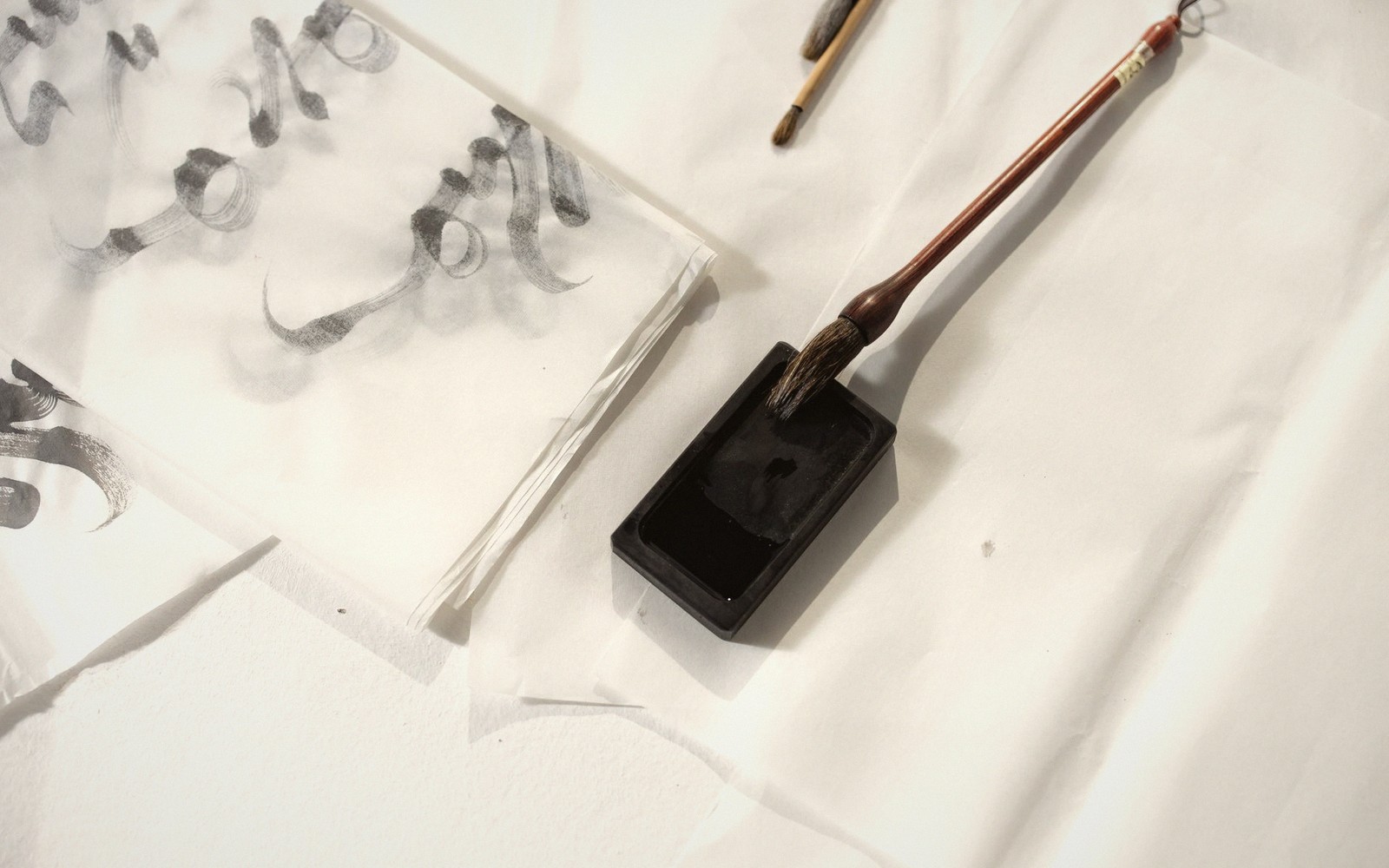
The art of East Asian calligraphy is half mark and half silence — and the silence is not an accident.
OneThe Stroke You Cannot Take Back
There is a particular quality of attention demanded by a brush loaded with ink above white paper. Unlike a pencil, ink cannot be erased. Unlike a keyboard, there is no delete key, no revision history. The brush touches the surface and the mark is made — permanent, expressive, irreversibly yours. This single fact restructures the practitioner's relationship with time. The moment before the stroke is not hesitation; it is preparation of the whole self.
East Asian calligraphy — practised across China, Japan, Korea and Vietnam in distinct but related traditions — is among the oldest continuously practised visual arts in the world. Chinese brush writing has roots stretching back more than three thousand years, with recognisable script forms appearing on oracle bones from the Shang dynasty. By the Tang dynasty in China (618–907 CE), calligraphy had been formally elevated as the highest of the visual arts, ranked above painting and considered the most direct expression of a cultivated inner character. The great Tang master Ouyang Xun and, earlier, Wang Xizhi — whose fourth-century Preface to the Orchid Pavilion Poems became the most revered piece of calligraphy in Chinese history — were studied, traced, and reverenced the way European painters once copied Raphael.
What makes this an art of presence rather than simply of skill is the brush itself. A flexible animal-hair brush responds to every nuance: the angle of the wrist, the pressure of the fingers, the speed of the arm, even the steadiness of the breath. A slight tension in the shoulder appears in the line. A wavering attention produces a wavering stroke. The brush is, in this sense, an instrument of self-disclosure — it does not lie about the state of the person holding it. Practitioners of shodo (Japanese: the way of the brush) speak of this not as a burden but as the point. The practice cultivates the practitioner.
TwoReading the White
Yet a finished work of calligraphy is not only its marks. The spaces between and around the characters — what Chinese aesthetics calls liubai, literally "leaving white" — are as considered as the strokes themselves. A master calligrapher does not fill a page; they compose it. The empty space breathes, gives weight to what surrounds it, and allows the eye to rest before moving on.
This is not a Western notion of negative space imported retrospectively onto an older tradition. Liubai is a formal concept taught deliberately in Chinese calligraphic training, related to — and inseparable from — the philosophical currents that shaped the arts across the region. Taoist thought, which prizes the usefulness of emptiness (the hollow of a bowl that allows it to hold, the space of a door that allows passage), flows directly into the aesthetic. A page crammed with ink, however technically brilliant each stroke, reads as anxious. A page with generous, considered white reads as composed.
Japanese shodo carries this further still. In Zen-influenced calligraphy, a single bold character brushed onto a long vertical sheet — enso, the ink circle; mu, the word for nothingness — can occupy a tiny fraction of the available paper. The expanse of untouched white is not emptiness waiting to be filled. It is the completion of the work.
A master calligrapher does not fill a page; they compose it.
ThreeSitting Down to the Practice
You do not need to read classical Chinese to begin. Calligraphy classes exist in most cities with East Asian communities, and materials — a basic brush, an ink stick, a grinding stone, and absorbent washi or xuan paper — are accessible and modest in cost. Beginners typically start by tracing printed model sheets of standard script (kaishu in Chinese, kaisho in Japanese), the clearest and most regular of the main script styles, before moving toward the more fluid semi-cursive and cursive forms.
The pedagogy is deliberately repetitive. You copy a character hundreds of times, not because the first hundred are failures but because repetition quiets the analytical mind and lets the hand learn. This is closer in spirit to meditation than to a studio art class. The goal of early practice is not expression but absorption — losing the self-conscious reaching for originality and arriving, instead, at something more settled. What often surprises beginners is how quickly the hour passes; how, afterward, the mind feels scrubbed clean.
This quality — attention gathered, the inner weather stilled — is what distinguishes calligraphy as a do, a way, rather than merely a skill. The brushstroke is made. The white remains. Both matter equally.
Wang Xizhi (c. 303–361 CE)
Chinese calligrapher whose Orchid Pavilion Preface is considered the pinnacle of the form
Mentioned in this guide
Ouyang Xun (557–641 CE)
Tang dynasty master calligrapher; his regular script remains a standard model
Mentioned in this guide
Orchid Pavilion (Lanting), Zhejiang, China
site of the famous 353 CE gathering where Wang Xizhi wrote his preface
Mentioned in this guide
- 3,000+ years agoRecognisable Chinese written script takes form.
- 353 CE · Orchid PavilionWang Xizhi writes the Lanting Preface, long held as the form’s summit.
- 618–907 · Tang dynastyCalligraphy is formally elevated to the highest of the visual arts.