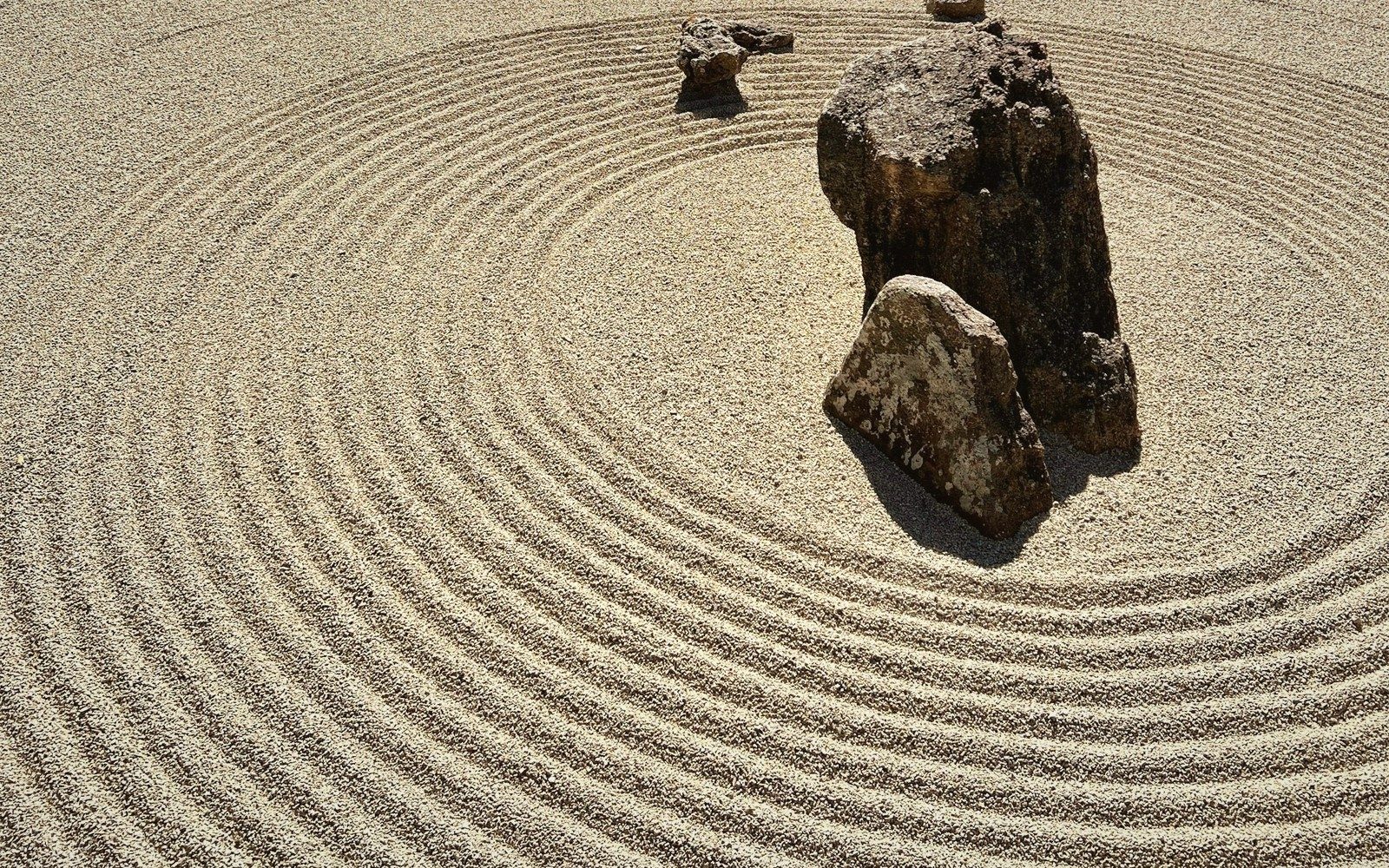
Raked gravel, a few stones, a great deal of empty space — a beginner's guide to seeing what's there.
OneWhat you're looking at
The first encounter with a dry landscape garden — karesansui in Japanese — tends to produce a particular expression: a slight frown, a pause, then the slow realisation that you have been looking but not yet seeing. This is not a failure. It is, in some ways, exactly the right response. The garden is doing its job.
Karesansui emerged in Japan during the Muromachi period, roughly the fourteenth and fifteenth centuries, reaching its most concentrated form in the Zen temple gardens of Kyoto. The most visited is Ryōan-ji, whose rectangular court of raked white gravel and fifteen stones has been studied, argued over and quietly contemplated for more than five hundred years. Stand at the veranda and you will notice immediately that no matter where you position yourself, one stone is hidden behind another. All fifteen are never simultaneously visible. Whether this was intentional — a teaching about partial knowledge, about the limits of any single vantage point — or simply a result of careful composition, no one can say for certain. The ambiguity is itself instructive.
The garden is made of almost nothing: gravel, stone, perhaps a little moss. What it gives back depends on what you bring to it and how long you stay.
TwoThe grammar of gravel and stone
Raked gravel — samon, the patterns left by the rake — is not decoration. It is drawing. The most common pattern runs in parallel lines that curve around the base of stones, the way water curls around rock, the way breath moves around a body at rest. This is not metaphor applied after the fact; it is the original intention. The gravel is water, and the stones are islands, mountains, or whatever the garden's composition requires. The Japanese call this representational approach mitate — seeing one thing as another, a principle that runs through poetry, theatre and the arrangement of flowers.
But the gravel is also simply gravel. Both readings coexist. A practised eye holds them at once without resolving the tension, which is close to what Zen training is actually asking of the mind: to remain present without collapsing experience into a single neat explanation.
Stone placement follows principles that were codified and debated by garden designers for centuries. Odd numbers are preferred — three stones, five, seven — because asymmetry resists the eye's tendency to lock on to a centre and stop looking. A single upright stone (tate-ishi, the vertical) is often balanced by a lower, recumbent form (fuse-ishi), and perhaps a transitional stone between them. The group reads as a sentence. Different groupings, distributed across the garden's expanse, create a rhythm — call and response, rest and movement — that you feel before you consciously analyse it.
How to actually look Most visitors spend four or five minutes at Ryōan-ji.
ThreeHow to actually look
Most visitors spend four or five minutes at Ryōan-ji. The garden asks for longer. The tradition it comes from does not reward speed.
Begin at one end of the veranda and sit, if the temple permits it. Let your eyes settle without hunting for meaning. Notice what the light is doing: flat overcast light flattens the gravel into something almost paper-like; low morning or afternoon sun throws the rake lines into relief and makes the garden sculptural, three-dimensional, almost restless. The garden changes with every hour.
Then move — slowly, along the veranda — and watch how the composition shifts. The stones regroup. New depths open. What appeared to be a flat field reveals itself as a series of carefully calibrated intervals, the empty spaces between stones as deliberate as the stones themselves. This is stone, water, and emptiness made literal: the unfilled ground is not background. It is the work.
If you find your mind generating interpretations — this stone is Mount Fuji, the raked lines represent the ocean — notice that too, without particularly trusting it. The garden supports multiple readings and endorses none of them. Its meaning is not solved; it is inhabited.
Ryōan-ji
Zen temple in Kyoto; home of Japan's most famous karesansui garden
Mentioned in this guide
Kyoto
city in Japan; historic centre of Zen temple garden culture
Mentioned in this guide
Muromachi period
Japanese historical era, roughly 1336–1573
Mentioned in this guide
FourWhat the garden is for
Karesansui was never designed as a walking garden. Unlike the strolling gardens of the same era, it is viewed from the edge, from stillness, from a fixed relationship between the body and the scene. This is unusual in Japanese garden design and reflects the specific priorities of the Zen temples that commissioned these gardens: they were aids to zazen, seated meditation, visible from the monks' hall, offering the mind a structured emptiness to rest against.
You do not need to meditate formally to use them that way. Simply standing or sitting at the veranda edge, watching without agenda, is already a version of the practice. The garden does not require belief or initiation. It requires only a willingness to stop, look slowly, and resist the rush to conclude.
The gravel will be raked again tomorrow. The stones are where they have been for centuries. Nothing is happening. Everything is available.
- 14th–15th c. · Muromachi JapanDry landscape (karesansui) gardens reach mature form in Kyoto’s Zen temples.
- Late 15th c. · Ryōan-jiThe famous court of raked gravel and fifteen stones is composed.
- 500+ years onThe same stones, raked anew each morning, are still contemplated today.