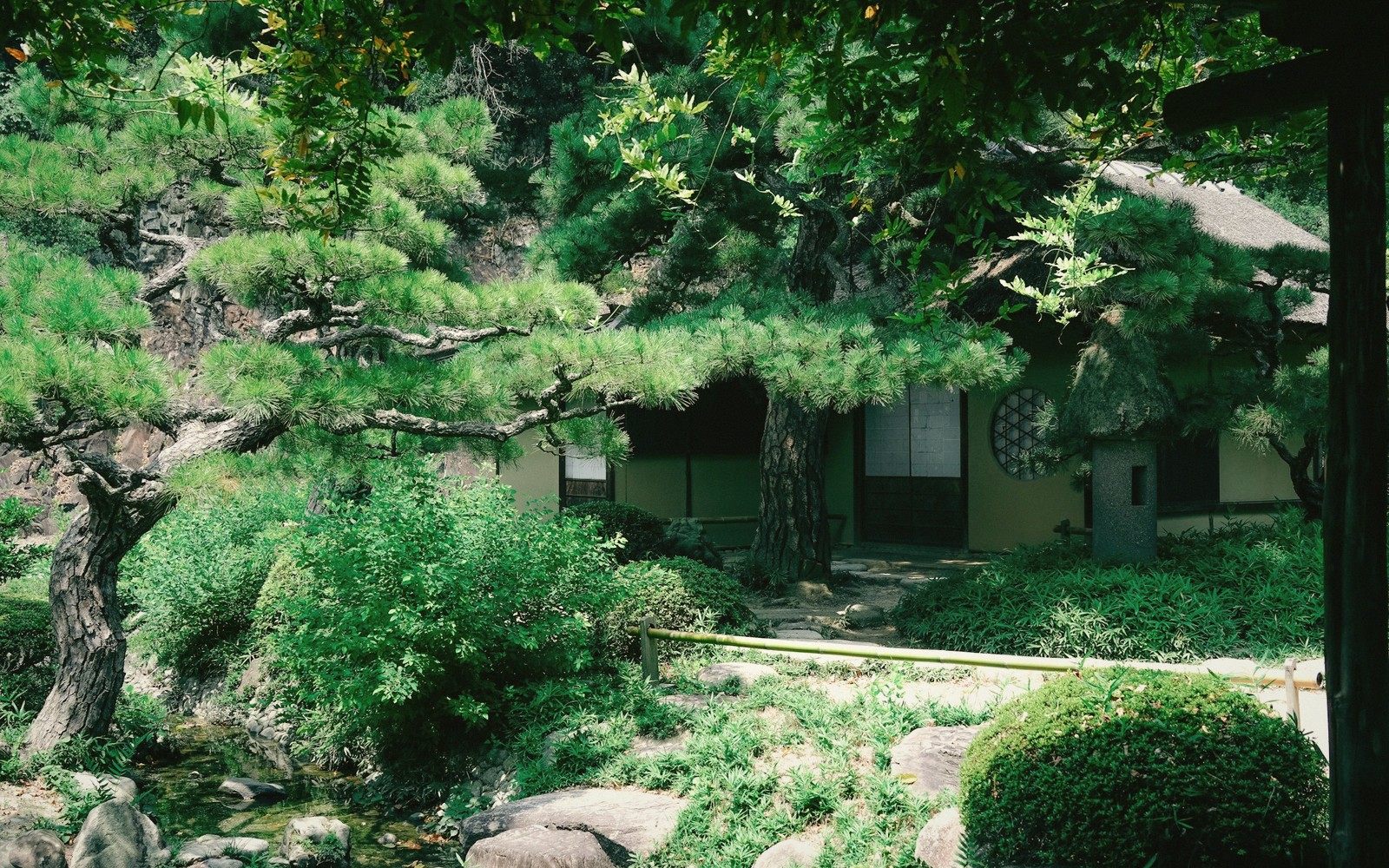
Stone, water, plant and path — the grammar of a garden built to be walked slowly.
OneThe Idea Before the Materials
A Japanese garden is not decorated land. It is composed land — shaped according to principles refined over more than a thousand years, drawing on Chinese garden philosophy, Shinto reverence for natural forms, and Zen attention to emptiness and interval. The materials are simple: stone, water, plants, gravel, path. What distinguishes a Japanese garden is the relationship between them, and the particular quality of stillness those relationships produce.
The oldest extant garden-design text in Japan, the Sakuteiki, was written in the late Heian period — around the eleventh century — and its central instruction holds across every tradition since: place stones as they wish to be placed, following the mood of the site. That instruction is less mystical than it sounds. It means read the land before imposing a plan, and let each element feel inevitable rather than arranged.
TwoStone, Water, Plant, Path
Stone is the skeleton. In Japanese garden aesthetics, stone carries sei — a quality of spirit or presence — that makes it more than inert material. Stones are chosen for shape and surface: a tall, vertical stone reads as active; a flat, horizontal one as settled. Groupings almost always use odd numbers, with one stone slightly dominant and the others in tension with it. What matters is the interval between them — the empty ground the stones frame — as much as the stones themselves.
Water gives a garden its voice and its movement. In kaiyū-shiki gardens (the stroll gardens of the Edo period, such as Korakuen in Okayama or Katsura Rikyū in Kyoto), water moves through streams and ponds that visitors circle, discovering new compositions at each turn. In a dry-landscape karesansui garden, water is absent and yet everywhere: raked gravel stands for sea or river, its surface rippled or combed in patterns that imply current and tide. The suggestion carries remarkable force precisely because nothing flows.
Plants are used with restraint. Moss is perhaps the most valued surface in a Japanese garden — soft, slow-growing, intensely green, and exquisitely sensitive to moisture; the gardens of Saihō-ji in Kyoto, known popularly as Kokedera (the Moss Temple), hold more than a hundred species. Maples (momiji) are planted for autumn fire; pines are pruned — sometimes over decades — into silhouettes that read as living calligraphy against the sky. Flowering plants appear, but rarely as masses of colour: a single plum at the garden's edge, a camellia in a dark corner. The principle is restraint as emphasis — each plant selected so that it means something.
Path transforms the garden from scene into experience. The tobi-ishi, or stepping-stone path, asks the walker to look down and adjust their pace. Irregular stones spaced for a considered step slow the body before the mind follows; wide, flat stones invite a pause, a turn, a longer gaze. The path does not simply connect points — it choreographs attention. A bend that hides the next section is not a design trick; it is a built argument for the present moment.
The tobi-ishi, or stepping-stone path, asks the walker to look down and adjust their pace.
ThreeScale and Enclosure
Japanese gardens work at almost any scale. The tsubo-niwa — a courtyard garden of just one or two tsubo (a tsubo is roughly 3.3 square metres) — uses the same grammar as a vast stroll garden, compressed. A few stones, a patch of moss, a single plant, a lantern: enough. Enclosure is part of the design. Walls, fences and clipped hedges frame borrowed views and block others, making the garden feel complete within its boundary, however modest.
That sense of completeness is the real ambition. A Japanese garden is not meant to overwhelm or astonish with abundance. It is meant to settle the visitor into a particular quality of attention — slow, receptive, unhurried. The raked gravel holds the rake-mark; the stone holds the moss; the path holds the footstep. Each element keeps a record of time passing without making it heavy.
How to read a Zen garden — its raked stone, its deliberate emptiness — is one entry into this language. A small garden of calm can apply the same grammar with a balcony and a bowl. The elements are old, but the practice of composing them — choosing one stone, placing it with care, watching how the light moves across it — is as available now as it ever was.
Saihō-ji (Kokedera)
Zen Buddhist temple and garden in Kyoto, celebrated for moss; over a hundred species
Mentioned in this guide
Katsura Rikyū
imperial villa and stroll garden in Kyoto, Edo period
Mentioned in this guide
Korakuen
Edo-period stroll garden in Okayama, one of Japan's three celebrated gardens
Mentioned in this guide
- 11th centuryThe Sakuteiki, the oldest Japanese garden text, sets down its principles.
- Heian–MuromachiPond-and-stroll and dry gardens develop side by side.
- Edo periodKatsura Rikyū and Kōrakuen refine the walking garden to its height.