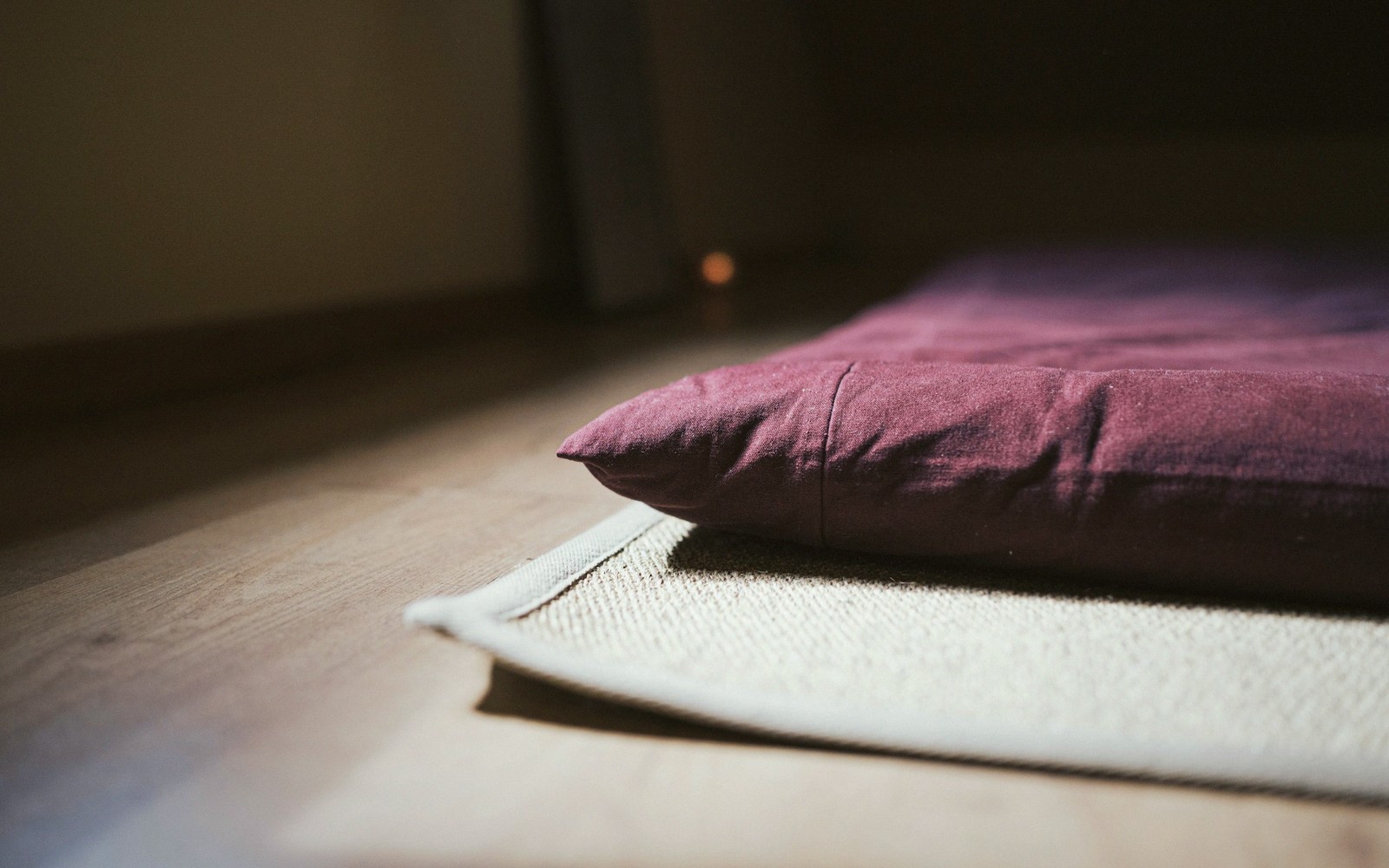
Meditation without the mystique — how to simply sit, and why it's harder than it sounds.
OneThe difficulty is the point
Most people who try meditation for the first time are surprised by the same thing: not boredom, not discomfort, but noise. The moment you sit down and close your eyes, the mind — which seemed perfectly ordinary a moment ago — reveals itself to be a very crowded room. Thoughts arrive uninvited. The list of things you forgot to do assembles itself with sudden urgency. You become aware of an itch, a sound from the street, the texture of the cushion under you. Thirty seconds in, you wonder if you're doing it wrong.
You're not. This is exactly what sitting still is for — not to silence the room, but to notice that it was always this loud.
The word meditation covers a broad territory. It appears in Taoist practice, in Chan and Zen Buddhism, in Theravada traditions from Southeast Asia, in Indian yogic lineages. The specific techniques differ considerably. But the thing they share is simpler than any of them: the deliberate act of sitting with attention, watching what the mind does when you stop directing it. That observation — patient, unjudging — is the practice itself.
TwoHow to begin
You need less than you think. No incense, no cushion, no app. A chair is fine. The floor is fine. What matters is the spine: upright but not rigid, the posture of someone who is awake and paying attention rather than someone who is trying very hard. Hands resting, eyes lowered or closed, jaw slightly loose. That's it.
In the oldest sitting traditions — Japanese zazen, for instance, as practiced in Zen monasteries — the physical form does matter. The full or half lotus position, the particular placement of the hands in the cosmic mudra (oval, left hand cradled in the right, thumbtips lightly touching), the eyes open and cast downward at a 45-degree angle. These aren't arbitrary. The form is understood to support the quality of mind; body and attention are not separate things. But these refinements are for later, or not at all. They're certainly not the gate.
Pick a length of time you can honestly commit to. Five minutes is not a trivial amount of time to sit still — try it before you dismiss it. Ten minutes is a real practice. The duration matters far less than the regularity: once a day, same rough time, is worth more than a long session once a week.
What to do with the mind There are entire libraries on this question.
ThreeWhat to do with the mind
There are entire libraries on this question. For a beginner, one approach is as good as any: bring your attention to the breath. Not controlling it, not deepening it — just noticing it. The sensation of air at the nostrils, or the slight rise of the chest, or the pause at the end of the exhale. Choose one place to rest the attention and return to it, gently, whenever you notice you've wandered.
The wandering is not failure. The return is the practice. If you sit for ten minutes and notice you've drifted forty times, you've also returned forty times — that's forty small moments of waking up. Over weeks and months, those moments begin to feel familiar in daily life too, not just on the cushion.
Some traditions use a counted breath — one to ten, then begin again — as a way of giving the mind something just difficult enough to occupy it without consuming it. Others use a word or short phrase, repeated silently. Others sit with no object at all, a practice sometimes called shikantaza in Zen: simply sitting, openly, without a project. This last approach sounds easy and is genuinely hard.
Zen
Japanese Buddhist tradition emphasising direct experience and seated meditation
Mentioned in this guide
Theravada
Buddhist school prevalent in Sri Lanka, Thailand, Myanmar, and Cambodia
Mentioned in this guide
FourThe longer argument
Why bother? This is a fair question, and the answer needn't reach for the grand.
There is something quietly countercultural about choosing to sit without producing anything. In a world organised almost entirely around output and stimulation, the act of sitting — not listening to something, not scrolling, not even consciously relaxing — is its own kind of statement. The contemplative traditions that gave us this practice understood it as a form of clarity, not escape: a way of seeing one's own mind more plainly, and from that clearer seeing, meeting the rest of life with a little more steadiness.
You don't have to sign up for a tradition to find this useful. Breath and the everyday has something to say about the smallest version of this — the single conscious breath taken anywhere. But sitting still, formally, even for a few minutes, is a different register. It asks something of you. That's precisely what makes it worth doing.
Start tomorrow. Sit for five minutes. Notice how hard it is. That's the beginning.
Written as living culture and personal practice — not medical advice, and not a therapeutic claim.
- Traditionally 6th c. · BodhidharmaChán (Zen) meditation is carried from India into China.
- 12th–13th c. · to JapanZen and seated meditation (zazen) take root in Japan.
- Now, anywhereThe instruction is unchanged: sit down, and simply sit.